
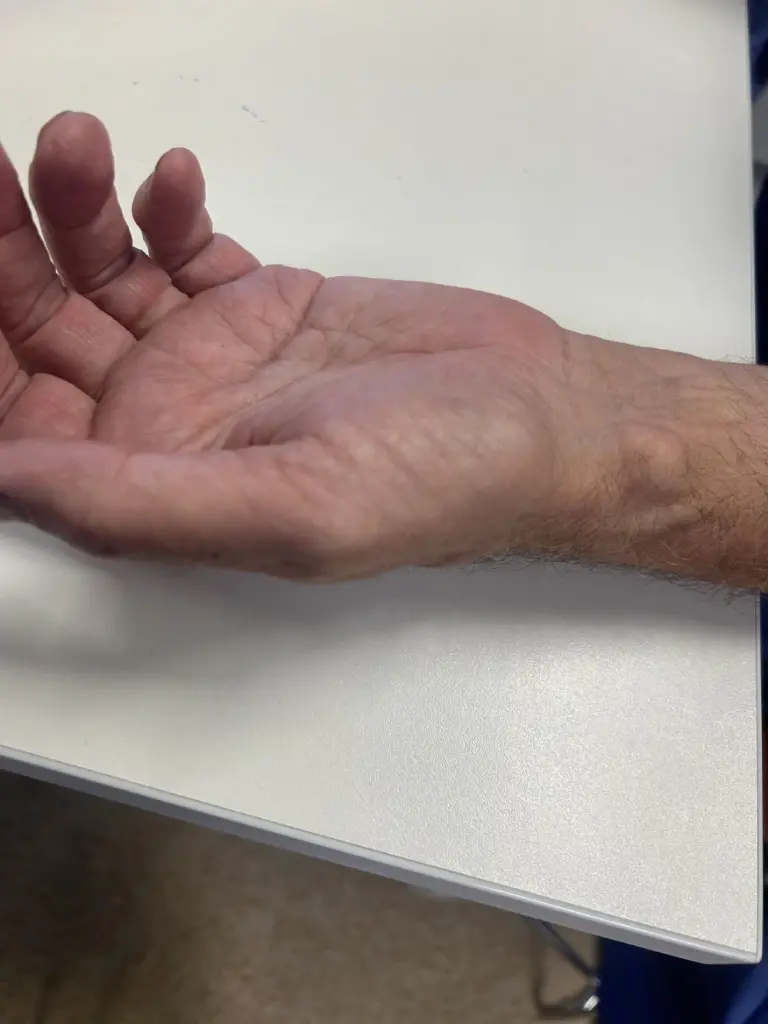
Ganglia
Ganglion cysts are the commonest type of swelling the hand. They contain a thick clear liquid called synovial fluid, which is the body’s lubricant in joints and in the tunnels through which some tendons run. Although ganglion cysts can arise from any joint or tendon tunnel, there are four common locations in the hand and wrist – in the middle of the back of the wrist, on the front of the wrist at the base of the thumb, at the base of a finger on the palmar side, and on the back of an end joint of a finger.
What Is The Cause?
A ganglion cyst arises when the synovial fluid leaks out of a joint or tendon tunnel and forms a swelling beneath the skin. The cause of the leak is generally unknown.
What Are The Symptoms?
A swelling becomes noticeable. It may or may not be painful.
How Is The Diagnosis Made?
The diagnosis is usually straightforward as ganglion cysts tend to be smooth and round, change in size from time to time and occur at characteristic locations in the hand and wrist. If the diagnosis is uncertain, x-rays or scans may be helpful.
What Is The Treatment?
Ganglion cysts are harmless and can safely be left alone. Many disappear spontaneously and many others cause little trouble. For ganglion cysts in general, the possibilities for treatment:
- Explanation, reassurance, wait to see if the cyst disappears spontaneously
- Removal of the liquid contents of the cyst with a needle (aspiration) under local anaesthetic
- Surgical removal of the cyst
For any individual cyst, the recommendations for treatment will depend on the location of the cyst and on the symptoms that it is causing.
Dorsal wrist ganglion cyst. Typically occurs in young adults and often disappears spontaneously. Aspiration can reduce the swelling but it often returns. The risk of recurrence after surgery is around 10%, and problems after surgery include persistent pain, loss of wrist movement and painful trapping of nerve branches in the scar.
Palmar wrist ganglion cyst. May occur in young adults, but also seen in association with wrist arthritis in older individuals. Aspiration may be useful, but care is needed as the cyst is often close to the artery at the wrist (where you can feel the pulse). The risk of recurrence after surgery is around 30%, and problems after surgery include persistent pain, loss of wrist movement and trapping of nerve branches in the scar. For these reasons, many surgeons advise against operation for these cysts.
Flexor tendon sheath ganglion cyst. Typically occurs in young adults, causing pain when gripping and feeling like a dried pea sitting on the tendon sheath at the base of the finger. Puncture of the cyst with a fine needle can disperse it – like puncturing a balloon – and fewer than half return. Persistent cysts can be removed surgically and the risk of recurrence is small.
Dorsal digital ganglion cyst. Usually in middle-aged or older people and associated with wearing out of the end joint of a finger. Pressure from the cyst may cause a furrow in the fingernail. Occasionally the cyst fluid leaks through the thin overlying skin from time to time. The risk of recurrence after surgery is around 10%, and problems after surgery include infection, stiffness and pain from the worn out joint.